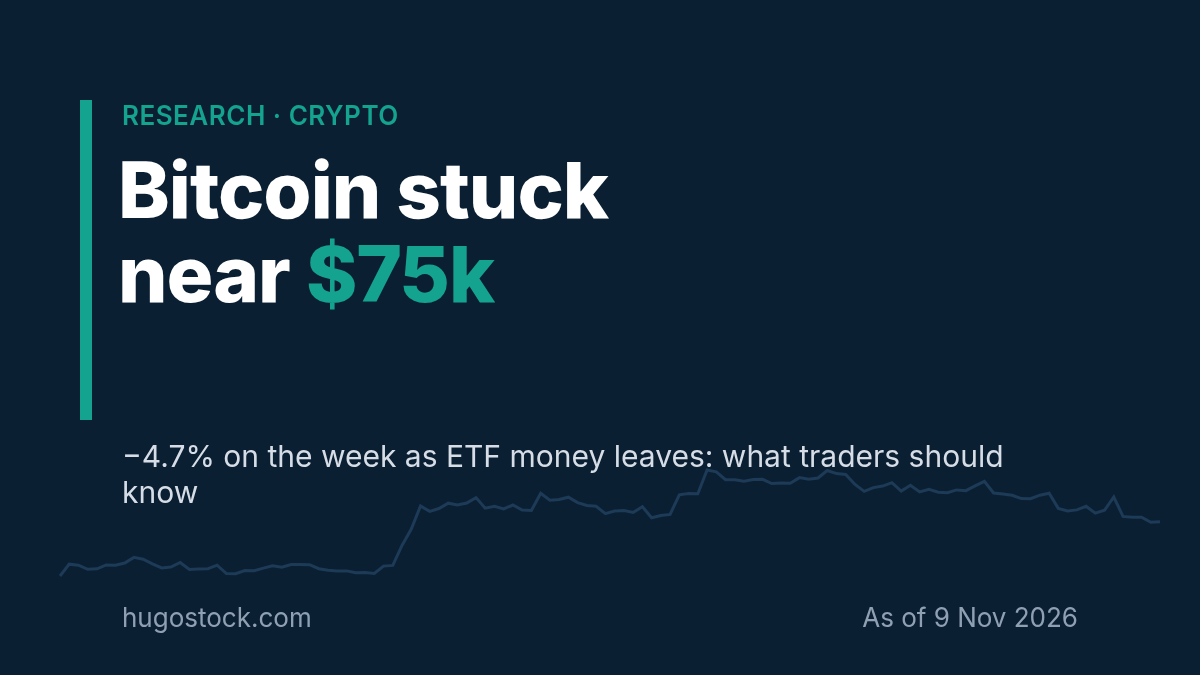
Bitcoin fell about 4.7% over the week of 2–8 November 2026, closing Sunday near $74,600 after dipping below $75,000 twice, as US spot Bitcoin ETFs saw about $1.28 billion of net outflows and a post-midterm tech sell-off hit risk assets. Here is what drove the move, how Bitcoin traded against stocks and gold, and what traders are watching next.
As of 9 November 2026. Bitcoin prices use UTC daily closes (00:00 UTC). US equity and bond figures use US Eastern (EST, UTC−5) sessions. Times below are EST, with South African time (SAST) in brackets.
Key numbers
- The week: Bitcoin closed Sunday 1 November at $78,248 and Sunday 8 November at $74,585 (UTC), a fall of about 4.7%.
- Dips below $75k: Friday 6 November low $74,767 (15:00–16:00 UTC); Sunday 8 November low $73,591 (21:00–22:00 UTC, 23:00 SAST). It stayed mostly below $75k into Monday.
- ETF flows: US spot Bitcoin ETFs saw −$1,281.7m over 2–6 November (Farside). BlackRock’s IBIT −$1,209.5m (94% of the net); Fidelity’s FBTC +$93.1m.
- Tech knock-on: Thursday 5 November — SOX −12.25%, Nasdaq 100 −6.36%; Bitcoin −5.55% that UTC day after weak Qualcomm and Arm results and the post-midterm AI/data-centre scare.
- Payrolls: October nonfarm +165k vs about 60k expected; unemployment 4.1%; August–September revisions +84k combined.
- Fed path: CME FedWatch odds of a 25 bp December hike about 77–81% by 6–9 November (press reports of FedWatch).
- Dollar & yields: DXY +0.4% on the week (almost all on Friday); 10-year Treasury yield 4.94% → 4.86%.
- Correlation: 30-day BTC correlation 0.71 with the Nasdaq 100 and 0.32 with gold; gold futures +4.5% on the week while Bitcoin fell.
Bitcoin (BITSTAMP:BTCUSD), two-year daily price chart. Chart: TradingView.
What happened
Bitcoin opened the week near $78,250 after the prior Sunday close and slipped on Monday. A post-midterm relief spike on Wednesday 4 November took the UTC high to $81,080 and the close to $80,405. Thursday’s tech rout reversed that: Bitcoin closed $75,942 (−5.55% on the UTC day), with about $1.25 billion of liquidations that day, 89% of them longs, according to CryptoQuant contributor data.
Friday’s payrolls print and the US open pushed an hourly low to $74,767, then a recovery back above $75,700. Saturday was flat near $75,750. Sunday evening brought a deeper break: a low of $73,591 around 23:00 SAST and a Sunday UTC close of $74,585. On Monday 9 November the latest quote in the source set was about $74,730 around 17:02 SAST.
Measured Sunday close to Sunday close (UTC), the week was about −4.7%. A ~−2% reading only appears if the window is Friday-to-Friday; that is not how this week’s report is framed.
ETF money left — mostly via IBIT
US spot Bitcoin ETFs recorded −$1,281.7 million of net flows from Monday 2 to Friday 6 November, per Farside Investors. BlackRock’s IBIT accounted for −$1,209.5 million — 94% of the week’s net. Fidelity’s FBTC was a partial offset at +$93.1 million. Excluding IBIT, the rest of the field lost only about $72 million.
The largest single ETF days were Monday (−$398.6m) and Thursday–Friday (−$430.2m and −$411.9m). IBIT’s outflow streak reached six sessions from 30 October. Cumulative net inflows since the products launched remain about $55.8 billion on Farside’s total row.
Why risk assets sold off
Three macro forces did most of the damage to Bitcoin this week:
- A post-midterm AI and chip rout. Midterms were Tuesday 3 November. Stocks first rallied on Wednesday, then Thursday 5 November brought Nasdaq 100 −6.36%, Nasdaq Composite −5.52%, S&P 500 −4.36% and the PHLX Semiconductor index (SOX) −12.25% — SOX’s worst day since March 2020, per NBC News. Triggers included newly elected candidates pledging to curb AI data centres, plus mixed Qualcomm and Arm results released Wednesday night. Bitcoin fell with tech that day.
- Hot October payrolls. Friday 6 November’s Employment Situation showed +165k jobs against a consensus near 59–65k, unemployment at 4.1% (from 4.2%), and +84k of combined upward revisions to August and September. Average hourly earnings rose 0.4% on the month and 3.1% on the year.
- Higher odds of a December Fed hike. CME FedWatch odds of a 25 basis-point hike at the 8–9 December meeting dipped toward about 60% during Thursday’s tech rout, then rose to about 77–81% after payrolls through 9 November, according to press reports of FedWatch. The funds rate is 3.75–4.00% after the 28 October hold (10–2).
The dollar was only modestly firmer: the DXY rose about 0.4% on the week (101.88 → 102.30), almost all of it on Friday. The 10-year Treasury yield actually fell, from 4.94% to 4.86%. So the “stronger dollar / rising yields” story was mainly a Friday front-end and dollar effect, not a week-long yield surge.
Binance hangover, not this week’s main driver
Binance’s ~$6.3 billion theft (the exchange’s own estimate; Chainalysis cites about $6.4 billion) was on Thursday 29 October — before this week started. The attacker used compromised hot-wallet signing, not a private-key leak; Binance said losses would be covered from SAFU and company funds. BTC’s sharpest hack-day drop was 29–30 October.
Withdrawals began reopening on Sunday 1 November. That day Binance processed about $4.65 billion of withdrawals versus $1.01 billion of deposits — a $3.64 billion net outflow, about 2.1% of its then ~$171 billion in assets. Restorations continued asset by asset through 8–9 November; some networks were still pending. Calling withdrawals “restored” overstates it. CryptoQuant contributor data showed Binance’s BTC reserve down about 9% by 2 November, with only a partial rebuild afterward. The hangover weighed on sentiment early in the week; the larger price damage inside 2–8 November tracked the tech rout and payrolls.
Trading like tech, not gold
Over a 30-day window ending Friday 6 November, Bitcoin’s daily-return correlation was about 0.71 with the Nasdaq 100 and 0.32 with gold futures (Yahoo closes; Hugostock calculation). The BTC–Nasdaq link jumped on the 5 November rout. Gold futures rose about 4.5% on the week (about $3,899 → $4,075) while Bitcoin fell — another sign Bitcoin is behaving as high-beta tech risk, not a gold substitute.
What to watch this week
All times are US Eastern (EST), with South African time (SAST) in brackets.
- Tuesday 10 November, 08:30 EST (15:30 SAST): US October CPI. Consensus for core is about +0.2% month on month. Unusual this month: the BLS will not publish year-over-year rates because October 2025 prices were never collected during the 2025 shutdown — expect noisy headlines.
- Fed speakers: Bowman, Waller, Barr and Jefferson appear through Friday (Fed calendar).
- Wednesday 11 November: Veterans Day holiday in the US. FOMC minutes follow on 18 November.
- Friday 13 November: October PPI; about $2.5 billion of Deribit Bitcoin options expire (roughly 33,400 BTC), with max pain near $78k.
- ETF flows: whether IBIT’s multi-day outflow streak breaks (Farside updates daily).
- Derivatives backdrop: aggregate BTC futures open interest was about $52 billion on 6 November; Deribit perp funding was roughly neutral into the weekend.
Levels traders are watching on Bitcoin (Yahoo daily closes through 8 November):
- ~$73.2k: the 200-day average — next support; price finished the week only a little above it.
- $73.6k / $74.8k: Sunday and Friday session lows.
- $75,000: the round number broken on Friday and Sunday.
- ~$78k: Deribit max-pain area into the 13 November expiry.
- ~$80–81k: Wednesday’s spike high and the 50-day average (~$81.7k) — reclaiming the 50-day would be an early trend-repair signal.
- $84k / $97.9k: October resistance band and the 2026 intraday high.
Bull and bear scenarios
What could stabilise or lift Bitcoin
- A cooler CPI print. Soft core inflation that pulls December-hike odds back toward the 60s, eases the dollar and lets chip stocks stabilise after a ~12% weekly fall.
- ETF redemptions slowing. IBIT turning flat or positive would remove a clear supply overhang.
- Binance finishing restorations and rebuilding reserves, reducing exchange-risk headlines.
- A reclaim of $78k then $80–81k, including the 50-day average.
What could keep pressure on
- A hot CPI print that locks in a December hike and lifts the front end and the dollar.
- A deeper tech correction while the 30-day Nasdaq correlation stays near 0.7.
- Persistent ETF outflows, especially from IBIT.
- A sustained break of ~$73.6k that puts the 200-day average (~$73.2k) and lower put strikes in focus, with elevated leverage able to amplify the move.
Our read: this was a risk-off week for Bitcoin as a tech-correlated asset, not a gold-like haven move. ETF redemptions (led by IBIT), Thursday’s chip crash and Friday’s hot payrolls explain most of the damage inside 2–8 November. The Binance theft was a pre-week shock whose withdrawal reopenings still matter for sentiment. Holding above the 200-day average keeps the chart from a clearer trend break; retaking $78–81k would be the first repair steps.
Market information only, not financial advice. See our Disclaimer.